This page provides information for our residential and business customers on network pricing.
MainPower provides distribution line services (poles and wires that deliver electricity to homes and businesses) to a population of over 80,000 people in the North Canterbury and Kaikōura region. Approximately 76% of our customer base is residential, with the majority of the remaining being small commercial, farming, or irrigation customers.
We consult with our customers on an annual basis to gauge their general level of satisfaction with the distribution services we provide, as well as on price and quality expectations.
MainPower generally performs well in terms of both reliability and quality of supply. Our customers also tell us they would definitely not be willing to accept poorer levels of power quality and reliability in exchange for a lower price or discount.
We’re here to help. Get in touch if you need help. Or, check out our FAQs.
Network pricing
MainPower does not bill customers directly for distribution lines services. Instead, we charge electricity retailers for the delivery of electricity over the MainPower network.
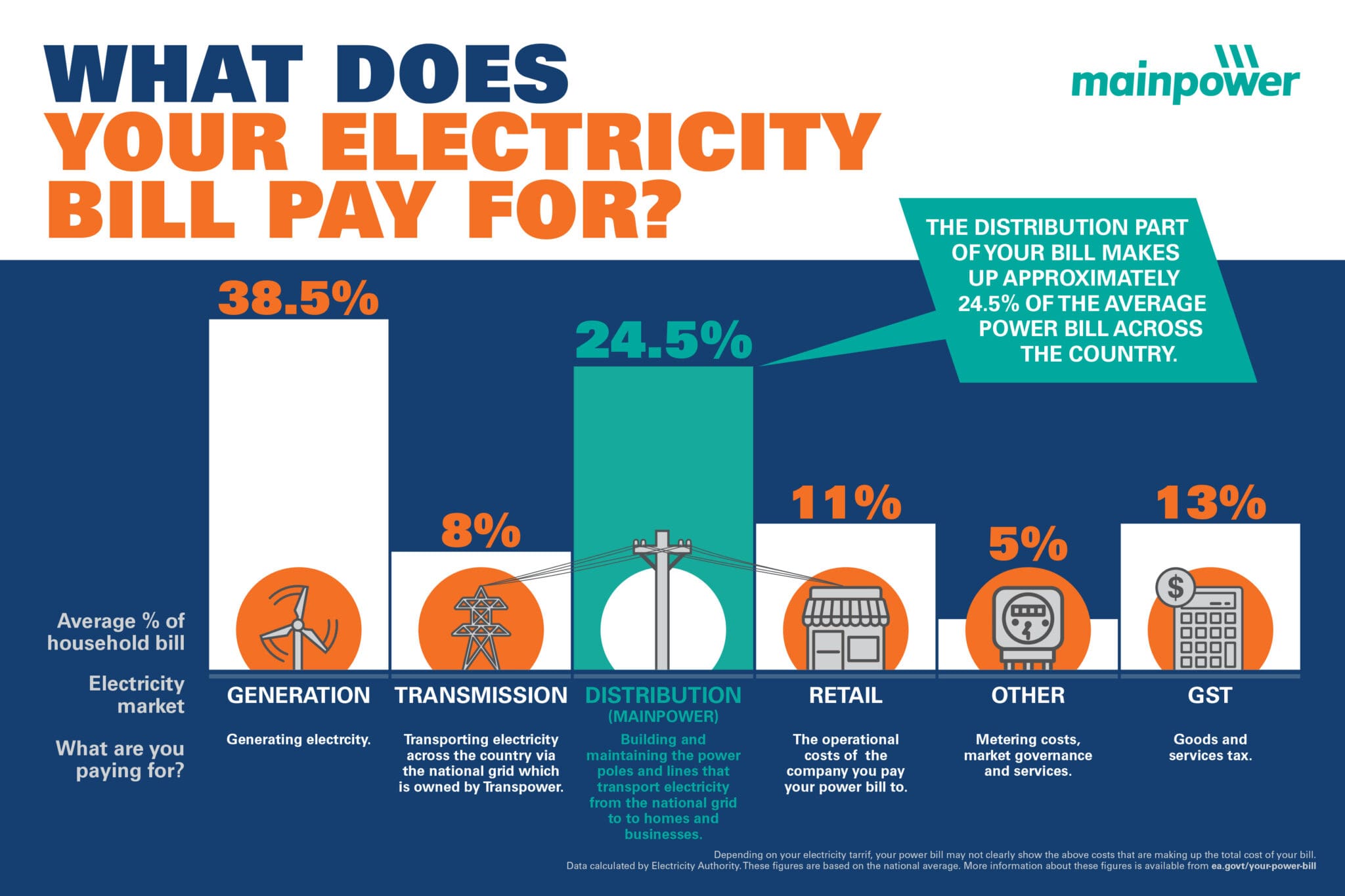
Electricity retailers determine how to allocate this cost, together with energy, metering and other retail costs, when setting the retail prices that appear on customers’ electricity bills. According to the Electricity Authority website, around 24.5% of your electricity bill goes to paying costs involved in the local distribution of electricity.
Need more information?
Please submit a request through our Get in Touch form if you’d like a member of our team to answer any further questions.
From 1 April 2026, MainPower’s network charges will be decreasing or remain the same.
The MainPower Board approved an increase to the rebate to offset higher distribution charges. This decision was intended to rebalance the funding burden for network development between current and future customers.
We will be pass through the 34.1% increase in transmission charges compared with the prior year. Transpower, increased its transmission charges for the MainPower network to $18.2m for the 2026-27 financial year (prior year $13.05m). MainPower is required by the Commerce Commission to pass these transmission charges through to consumers in our pricing. The Electricity Authority requires that these transmission charges be passed through as a fixed daily charge where possible.
To reduce the impact of the increased Transpower charges and increase in MainPower’s costs, we have increased our rebate from $10m in 2025/26 to $13.94m in 2026/27. This offsets the increase in MainPower’s lines charges.
The rebate is applied as a deduction from the fixed daily charge. The prices published in our network pricing document have already taken into consideration the rebate we offer to our customers in the coming year.
Customers connected to the former Kaiapoi Electricity network receive a discount applied to their fixed charge equivalent to the MainPower rebate.
All eligible customers receive the MainPower rebate. However, many retailers choose not to show this discount on their invoices.
For FY2026/27, MainPower absorbed the increase in operational costs required to build and maintain the distribution network by increasing the customer rebate, effectively capping the distribution cost impact on customers for that year.
We have passed through an increase in transmission costs. This is due to the national grid operator, Transpower, increasing its MainPower transmission fees to $182m for the 2026-27 financial year (prior year $13.2m). MainPower is required by the Commerce Commission to pass these transmission charges through to consumers in our pricing. The Electricity Authority requires that these transmission charges be passed through as a fixed daily charge where possible.
MainPower is continuing to adjust our prices to achieve a directive from the Electricity Authority, to reduce cross-subsidisation across our pricing. Previously, commercial customers have paid more for electricity to subsidise residential consumers. To meet the regulator’s expectations, we have changed the pricing to better reflect the actual cost to provide electricity to consumers.
MainPower continues to re-invest in the network as it continues to grow. More than 800 new customers are forecast to connect to the network in the coming year. In addition, a number of businesses are electrifying their operations and customers are adopting new technologies such as EVs. To meet the needs of the growing communities, manage shifting demand, and support the continued uptake of electrification technologies, while maintaining the current level of service, an increase in network development and maintenance spend is required.
From 1 April 2026.
This will depend on the pricing plan you are on and how your electricity retailer chooses to bundle the pricing on your electricity bill. The impact will vary depending on your individual circumstances and how much electricity you consume.
While MainPower’s costs will be included in your electricity bill, it is not always obvious which part of your bill we are responsible for as retailers may choose to package your pricing differently to our tariff. MainPower does not have any control over the amount your retailer charges you or how they display it on your bill. Some customers may find that their retailer does not pass on the changes immediately if their price plan is fixed for a period of time.
The average residential customer is likely to experience an decrease in their network charges of approximately 3.6% (around $4 per month). This decrease only applies to the transmission and distribution portion of the electricity bill sent by your chosen electricity retailer, not the overall bill.
Please contact your retailer if you wish to discuss pricing plans or visit the Powerswitch website (https://www.powerswitch.org.nz/) to make sure you are on the most suitable plan for you.
MainPower pays a rebate to Qualifying Customers i.e. customers connected to the MainPower distribution network (excluding customers on a builder’s temporary supply). Customers connected to the former Kaiapoi Electricity network are not Qualifying Customers.
The monthly rebate paid to Qualifying Customers is applied as a percentage discount off the fixed charge before we pass it on to the retailer. Some retailers choose not to show this discount on their invoices. Customers connected to the former Kaiapoi Electricity network will have a customer discount applied to their fixed charge equivalent to the MainPower rebate.
From 1 April 2026, the rebate and discount are set at 37% off the fixed daily charge for residential customers and 17% off the fixed daily charge for non-residential customers. The rebate is deducted off the lines charge when the charges are passed onto the electricity retailers and not passed onto the customer in the form of a cheque or refund paid directly by MainPower.
Your electricity bill is made up of several elements, one of which is the cost of delivering electricity to your property via MainPower’s network, a process known as distribution. The distribution charge accounts for around 24.5% of your total electricity bill and is made up of a combination of fixed and variable charges.
MainPower is also charged by Transpower for the costs of transmitting electricity from the electricity generators through the national grid to the MainPower network. We are required by the Commerce Commission to pass these charges through to consumers in our pricing. Transmission charges account for approximately 8% of your total electricity bill.
To find out more about what makes up your power bill, visit ea.govt.nz/your-power/bill/
The Commerce Commission decides how much money we can earn, making sure it covers our network’s operating and maintenance costs. MainPower, as a trust owned EDB chooses to follow the Commerce Commission directions.
The Electricity Authority manages how this money is shared among customers by setting guidelines on pricing structures.
The Government decided to phase out Low User Fixed Charges over five years from 2022-2027.
The Electricity (Low Fixed Charge Tariff Options for Domestic Consumers) Regulations known as “the low fixed charge regulations” were introduced in 2004 partly to reduce the impact of high fixed charges on customers with low consumption and fixed incomes and to encourage energy conservation. Under the regulation, MainPower, as the lines company for North Canterbury, was only able to charge customers eligible for the low user tariff 15 cents per day as a fixed charge. The electricity retailer was able to charge an additional 15 cents per day.
As time has passed, the low fixed charge regulations have had some unintended consequences. The regulations have had the effect of benefitting many customers who do not need assistance, for example small households in modern well-insulated houses, at the expense of larger families in poorly insulated homes.
The regulations also benefitted people who could afford to install solar PV panels to reduce their electricity bills at the expense of other customers who used more electricity.
Support that may be available and further information can be found at the following websites:
- Support available – MBIE
- Phasing out low fixed charge tariff regulations overview – MBIE
- Consumer article – Scrapping low use power plans will see many paying more for electricity
Since 01 April 2025, we have reduced the number of residential tariffs available. This will simplify our pricing and allow MainPower to be more flexible with our pricing in the future.
Customers who allow MainPower to control their hot water cylinder will continue to receive a discount to recognise the benefit the customer is providing. However, this is now accounted for as an ‘optional additions’ to the two remaining tariffs. Likewise, customers who were previously on the Night Only tariff will also be assigned to the Night optional addition.
We’re here to help
If you need some assistance or advice, please get in touch with our team.