Network Connection Charge Changes
Home / Network Connection Charge Changes
What’s changing from 1 April 2026?
Electricity is becoming more important in New Zealand. More homes, businesses and vehicles are switching to electricity. That means more people are applying to connect to local electricity networks, or to upgrade their existing connections.
The Electricity Authority (the independent regulator for the electricity industry) has introduced new rules with the intention to:
- improve consistency and transparency in how lines companies approach pricing throughout New Zealand
- reduce situations where the ‘first’ or ‘last’ customer pays much more than others
- make sure new connections pay their fair share of costs
- improve transparency so customers can better understand what they are being charged for.
These changes apply to all lines companies and start from 1 April 2026 (with one part starting from 1 April 2027). This is the start of a broader journey to increase connection pricing transparency.
There are four main changes.
1. Minimum scheme requirement (lowest-cost technically acceptable solution)
(From 1 April 2026)
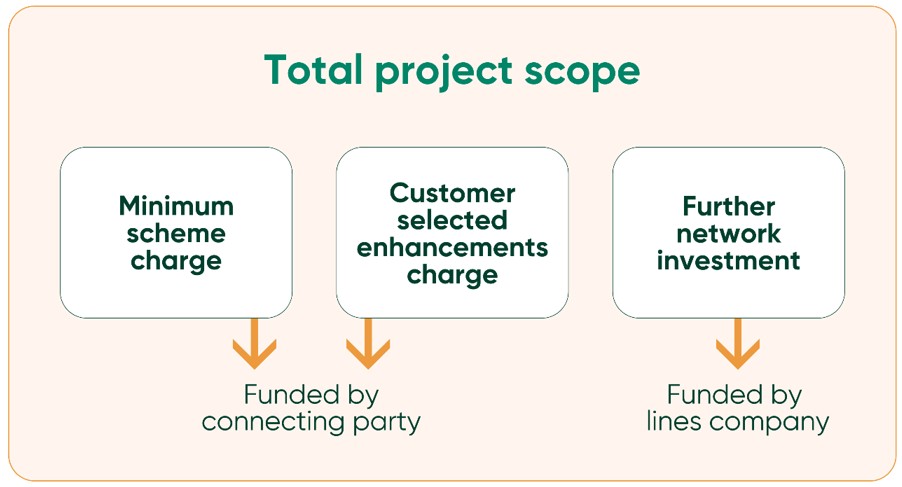
Lines companies must now base your connection price on the lowest-cost, technically acceptable solution for connecting you. This is called the ‘minimum scheme.’
What this means for you
- If you want a higher-spec solution (for example, extra redundancy or future-proofing), you can request it — but you may pay extra. You will not be charged for upgrades or enhancements you didn’t ask for.
- You can ask about flexible options (for example, agreeing to reduce load at peak times in exchange for lower costs).
2. Pioneer schemes (to address 'first mover' disadvantage)
(From 1 April 2026)
Sometimes, the first person to connect in a new area has to fund an extension of the network. In the past, later customers could benefit without contributing to the cost of the prior extension.
Under the new rules, if a connection triggers a significant extension, lines companies must set up a ‘pioneer scheme’ (with some exceptions, such as real estate developments).
Later customers who use that extension must contribute, and the earlier ‘pioneer’ customer may receive rebates.
What this means for you
If you are:
- The first to connect: you may receive contributions back if others connect later.
- Connecting later: you may be charged so that you are contributing to earlier shared infrastructure.
This is designed to make things fairer between early and later connections.
Scope
Lines companies may choose to offer more generous scheme terms, but as a minimum, schemes will apply:
- to connections over $50,000 (inflation-adjusted from Dec 2025 dollar terms)
- that are not related to connections for developments with the purpose of on-selling
- and will operate for seven years.
3. Connection charge reconciliation (greater transparency)
(From 1 April 2026)
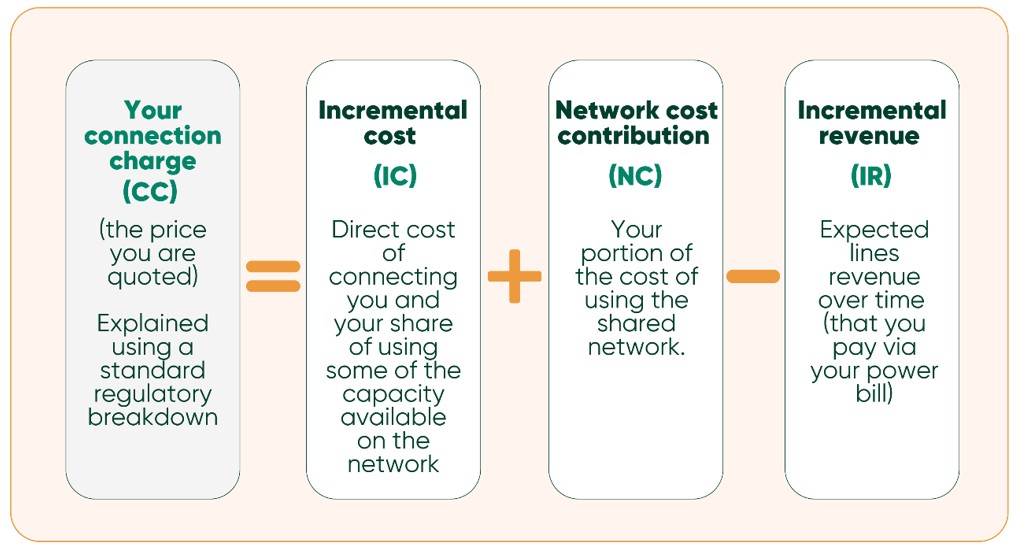
Lines companies must prepare a standardised breakdown of connection charges into:
- incremental costs (the direct cost of connecting you and your share of using some of the capacity available on the network)
- network cost contribution (your portion of the cost of using the shared network)
- incremental revenue (expected lines revenue over time – that you pay via your power bill).
This is called a ‘connection charge reconciliation.’
The reconciliation outcome shows how the connection charge compares to long-term costs and revenue using a consistent national format.
Important
This is mainly a disclosure requirement. It does not automatically change how lines companies set prices. It standardises how charges are explained and increases comparability.
What this means for you
- You can request a reconciliation showing how your connection charge is allocated.
- The reconciliation is for transparency — it doesn’t change your quote or create a new charge.
- It may group costs differently from your quote, because it follows a standard format set by the Electricity Authority.
The reconciliation you receive is detailed and complex. It summarises costs, revenue and network capacity components using standardised language. This reflects the standardised format and terminology required under new regulation. If you would like help understanding it, please get in touch with us.
- This is permitted under the Electricity Authority’s rules and reflects the average costs and revenue for that class of connection. It ensures transparency while avoiding unnecessary modelling for routine connections.
- If your connection involves a standard connection rate, you may not receive an individualised quote.
4. Capacity costing (new approach to network upgrades)
(Mandated from 1 April 2027 for pricing, used earlier in reconciliation)
What does capacity mean?
In simple terms, capacity is the amount of electricity the network is able to carry at one time.
Think of the electricity network like a system of roads:
- The wires and transformers are like roads and bridges.
- The electricity flowing through them is like traffic.
- Capacity is how wide the road is — how much traffic it can safely carry at once.
When you connect to the network or increase your load, you use some of that available capacity. If there isn’t enough spare capacity, parts of the network may need to be upgraded to handle the extra demand.
Capacity charges are about contributing fairly to the cost of making sure the network can safely carry the electricity you need — especially during busy times.
What’s changing?
If a lines company chooses to recover the cost of network capacity upgrades, it must use clear, published rates based on the cost of adding capacity. It cannot pass the full cost of an upgrade on to the customer who happens to trigger it. This reduces the risk that the final customer before an upgrade pays a disproportionately high amount.
Important
From 1 April 2026, this is only an estimated disclosure requirement. It does not automatically change how lines companies set prices. Published rates are only required from 1 April 2027. However, because of the disclosure requirement from 1 April 2026, some lines companies are choosing to early-adopt these changes to their underlying pricing.
What this means for you
- Charges for network capacity should become more predictable.
- You should not face a disproportionate charge simply because of timing.
What is not changing?
- Connection charges will still vary depending on location, size and technical requirements.
- The rules do not require all lines companies to charge the same amounts.
- Prices will still reflect the real costs of building and upgrading networks.
Why might impacts differ between regions?
New Zealand’s electricity networks differ in:
- geography
- customer density
- existing infrastructure
- historic pricing approaches.
Some lines companies may have little change to the amount they charge. Others may need to adjust how they allocate costs. This may result in some rebalancing between the cost you pay up front for the new connection, and the ongoing charge you pay as part of your power bill.
This means impacts for customers may vary depending on where you connect.
We’re here to help
If you need some assistance or advice, please get in touch with our team.